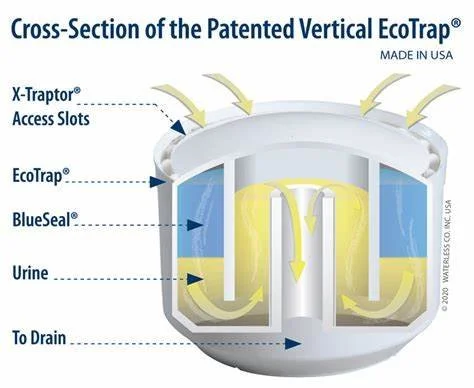
Inside an EcoTrap Trap/Cylinder from Waterless Co., Inc.
While skeptics once worried about malodors from of waterless (or no-flush) urinals, modern technology has proven those fears unfounded. When cleaned and maintained properly, these fixtures provide a sanitary, scent-free, and highly efficient restroom environment.
Interestingly, many janitorial experts prefer them over traditional models because the upkeep is often more straightforward. Here is how to keep your waterless systems performing at their peak.
1. Monitor the Trap and Sealant Level
The heart of any waterless urinal is its cartridge or trap mechanism. This component performs two vital roles:
Directing urine directly into the plumbing below
Creating a barrier with sealing liquid to prevent sewer gases from escaping.
Odors usually only appear if the sealant has evaporated or the cartridge needs to be replaced. Maintenance schedules depend on foot traffic:
Standard units typically need a refresh every 2 months.
High-capacity systems, such as the EcoTrap® pictured above, can function effectively for up to 6 months.
Quick Fix: If you notice a lingering smell, check the sealant level first. Adding a few ounces of liquid or swapping the cartridge usually solves the problem instantly.
2. Stick to "Dry-Friendly" Cleaning Techniques
Waterless urinals require a slightly different cleaning approach than their flushing counterparts. To avoid damaging the system, keep these rules in mind:
Avoid the "Bucket Flush": Never dump large volumes of water down the drain, as this can flush away the essential sealing oil.
Skip the Scrubbing: Since there is no standing water, you won't deal with hard-water scale. Aggressive scrubbing is unnecessary and can scratch the finish.
The Ideal Routine:
1. Apply a specialized cleaner (like NviroClean) or a mild all-purpose spray.
2. Let the solution sit for 60–120 seconds to neutralize bacteria.
3. Wipe the surface with a clean microfiber cloth.
3. Sanitize the surrounding "Splash Zone"
In any restroom, the fixture itself is rarely the only source of smells. "Splash-back" is a reality that affects the surrounding environment. Urine droplets can migrate to:
Adjacent walls and partitions.
The floor directly beneath the unit.
The underside of the urinal housing.
To combat this, ensure your cleaning crew mops the floor daily and wipes down all nearby vertical surfaces. If you use urinal mats, ensure they are replaced on a strict rotation or managed by a professional service to prevent them from becoming saturated.
4. Ensure Clear Drain Lines
If the urinal is well-maintained but malodors are present, the issue might be hidden further down the pipe.
Audit the Flow: Check for slow drainage during your routine inspections.
Take Action: Use a drain auger to remove minor obstructions. For persistent backups, it is best to call a licensed plumber to clear the lines professionally.
The Verdict: A Smarter Way to Go
Transitioning to waterless systems doesn't just save water; it simplifies the custodial workflow. Because there is no forceful flush, there is less aerosolized spray, meaning fewer germs on surfaces and a lower risk of inhaling chemical fumes.
By following these four steps, you ensure a facility that is sustainable, cost-effective, and—above all—perfectly fresh.