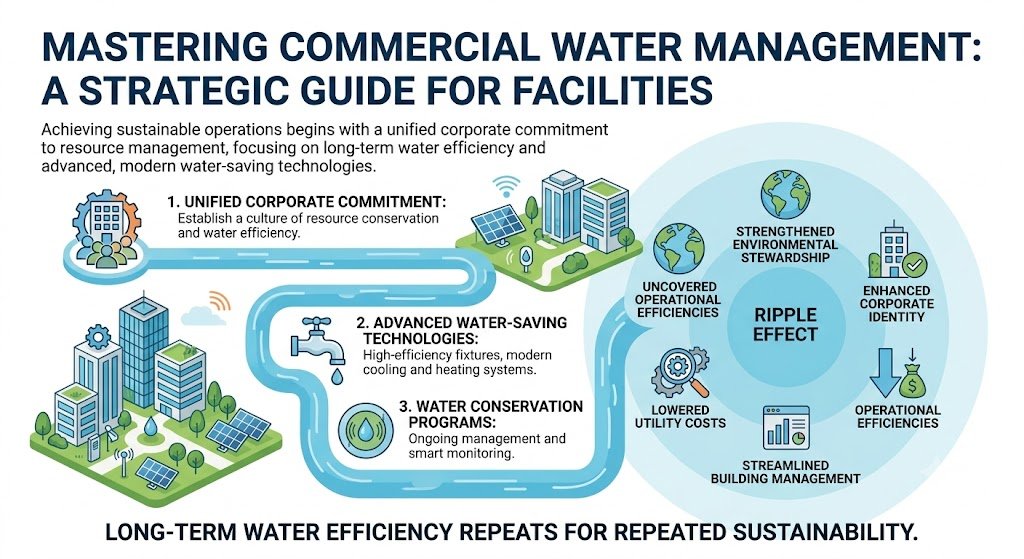
Achieving sustainable operations begins with a unified corporate commitment to resource management. For businesses and commercial facility managers, true sustainability requires shifting focus toward long-term water efficiency. Unlike temporary reductions, true efficiency is realized by integrating advanced, modern water-saving technologies into daily operations.
Beyond lowering utility costs, establishing a culture of water efficiency and conservation program ripples through an entire organization. It strengthens environmental stewardship, enhances corporate identity, and frequently uncovers hidden operational efficiencies that streamline overall building management.
The Foundation: Conducting a Facility Water Audit
You cannot manage what you do not measure. Developing a successful commercial water management plan requires a comprehensive building water audit. This process evaluates exactly how and where water is consumed throughout your property to pinpoint areas of waste and opportunity.
While smaller properties might attempt an initial assessment internally, larger or more complex facilities benefit significantly from hiring professional energy and water auditors.
Key Phases of a Commercial Water Audit:
Scope Definition: Explicitly mapping out which zones of the property will be analyzed (e.g., HVAC systems, restrooms, landscaped areas) and which will be excluded.
Data Aggregation: Gathering historical consumption records. Analysts typically require a minimum of 24 months of water utility bills to establish an accurate baseline that accounts for seasonal fluctuations.
Trend Analysis: Evaluating utility data to uncover usage patterns. Facilities utilizing localized submeters can isolate consumption data by specific departments or equipment types.
Opportunity Identification: Identifying specific operational changes or equipment retrofits that offer the highest return on investment (ROI).
Action Plan Creation: Formulating a structured water management policy to systematically implement the audit’s findings.
Important Note: A water audit is not a one-time event. Properties should repeat this assessment every two to three years. Critical mechanical infrastructure—such as cooling towers and commercial boilers—can degrade over time. A sudden, unexplained spike in their water consumption is often an early warning sign of impending mechanical failure.
Organizing Action Items: The Four-Bucket Strategy
A comprehensive audit usually uncovers dozens of ways to reduce consumption. To prevent project paralysis, facility managers can categorize these tasks into a practical, four-tiered priority framework:
1. Immediate Mandates
High-priority emergencies requiring instant intervention.
Repairing a major, hidden plumbing leak that is actively driving up utility costs.
2. Short-Term Gains
Low-cost, "low-hanging fruit" retrofits yielding fast returns.
Installing aerators or addressing minor maintenance tasks within six months of the audit.
3. Capital Improvements
Mid-to-high-cost upgrades aligned with scheduled renovations.
Upgrading to low-flow or waterless restroom fixtures during a planned facility remodel.
4. Long-Term Infrastructure
Major capital expenditures managed via lifecycle planning.
Replacing aging roof chillers every 7–10 years to prevent emergency breakdowns and costly expedited orders.
High-Impact Water-Saving Technologies
Once your action plan is structured, the next step is deploying modern solutions engineered to minimize resource waste. Consider integrating the following innovations:
Modern Restroom Fixtures
Restrooms represent the highest percentage of indoor water use in standard commercial buildings. Upgrading to high-efficiency fixtures is critical:
Ultra-Low-Flush Toilets: Modern commercial toilets use roughly 1.3 gallons per flush (GPF), performing well below the federal maximum mandate of 1.6 GPF.
Waterless Urinals: An increasing number of jurisdictions are mirroring strict conservation laws like Arizona's, mandates that require or heavily incentivize no-water urinals in new construction and retrofits to drastically lower utility and installation expenses.
Automated Sensor Faucets: Reliable touchless sensors eliminate user negligence by ensuring water flows only when actively needed.
Greywater Reclamation Systems
Commercial properties are moving away from the traditional, linear model of intake and drainage. Greywater systems capture non-potable, non-toxic discharge—such as water from handwashing sinks, drinking fountains, and gym showers—treat it on-site, and repurpose it for landscape irrigation or toilet flushing. As technology costs decline, these recycling systems offer increasingly attractive payback periods.
Advanced Infrastructure Monitoring
Comprehensive Submetering: Installing submeters across different building zones allows management to track localized usage spikes and rapidly isolate plumbing issues before they escalate.
Intelligent Leak Detection Platforms: These automated networks utilize digital sensors and smart monitoring software tied directly to automatic shut-off valves, alerting facility teams in real time the moment an anomaly occurs.
Smart Irrigation Controllers: Outside the building, smart controllers leverage live weather feeds and soil moisture data to eliminate wasteful overwatering during rain events.
The Long-Term Return on Investment
Implementing a data-driven commercial water management plan delivers advantages that extend far beyond lower utility bills. Because moving and heating water requires substantial electricity, reducing your facility's water footprint directly drives down energy consumption.
Furthermore, proactively adopting sustainable building practices strengthens your brand reputation. Modern consumers, clients, and stakeholders favor organizations that demonstrate verifiable environmental responsibility, making water efficiency a powerful competitive advantage in today's market.
Klaus Reichardt is CEO and founder of Waterless Co, Inc., a pioneer in advancing water efficiency. Reichardt founded the company in 1991 with the goal of establishing a new market segment in the plumbing fixture industry with water efficiency in mind. Reichardt is a frequent writer and presenter. He can be reached at klaus@waterless.com