Data centers are the backbone of today’s digital economy, powering everything from cloud computing and streaming services to advanced artificial intelligence (AI). But as these facilities expand, so does their environmental footprint—especially when it comes to water consumption.
In many regions, data centers now use as much—or even more—water than the communities around them. So, why do data centers use so much water, and what can be done to reduce it?
The Real Reason: Cooling Massive Heat Loads
At the core of the issue is heat. Data centers house thousands of servers operating 24/7, generating enormous amounts of heat that must be managed to prevent system failures.
Water has long been the most effective and widely used solution for cooling. While alternative technologies exist, most facilities still rely on water-based systems due to their efficiency and reliability.
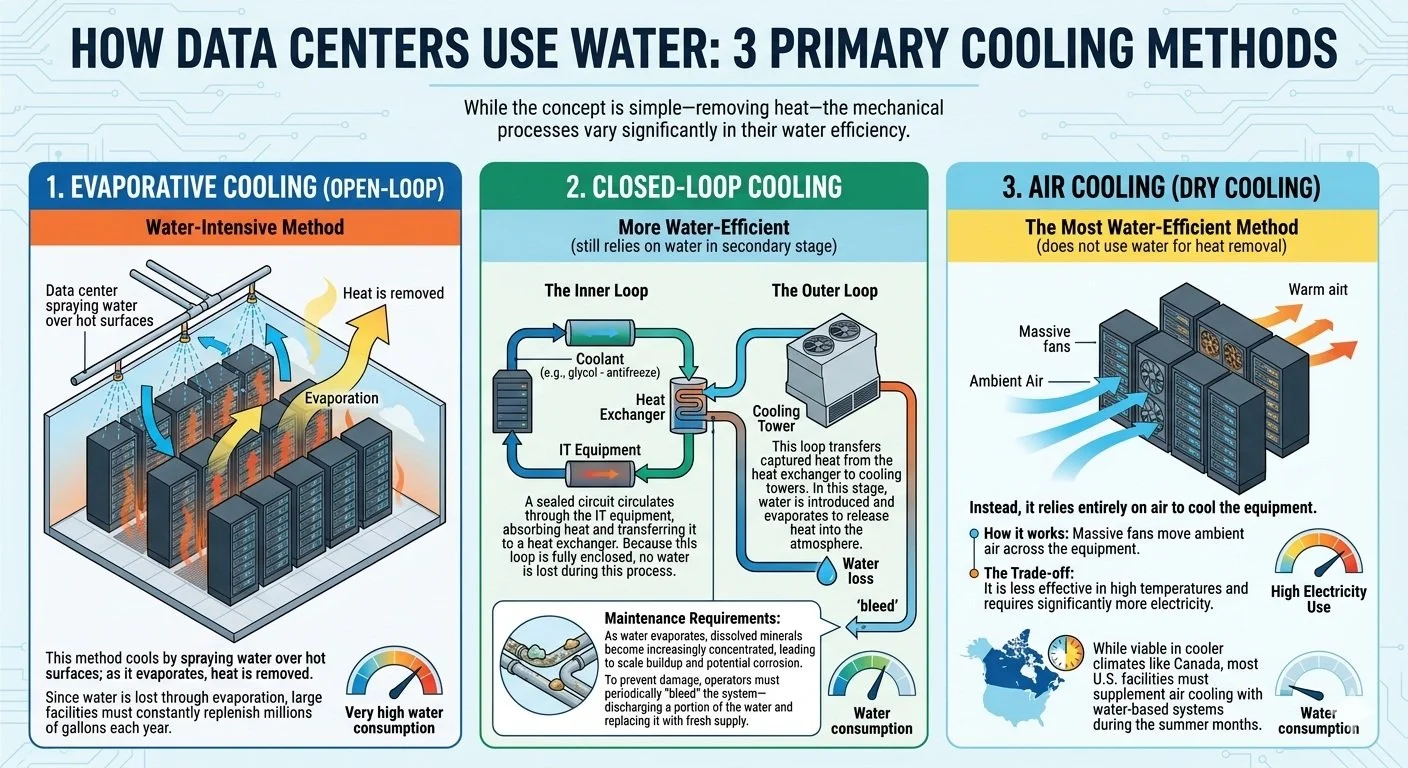
The 3 Main Data Center Cooling Methods
Not all cooling systems use water equally. Understanding the differences is key to evaluating their environmental impact.
1. Evaporative Cooling (Open-Loop Systems)
Evaporative cooling is the most water-intensive method used in data centers.
This system works by spraying water over hot equipment or surfaces. As the water evaporates, it removes heat—similar to how sweat cools the human body. However, the process consumes significant amounts of water because it is lost to the atmosphere and must be constantly replenished.
Large hyperscale data centers can use millions of gallons of water annually with this method.
2. Closed-Loop Cooling Systems
Closed-loop systems are often described as more water-efficient—but that can be misleading.
These systems operate with two interconnected loops:
Inner Loop:
A sealed system, typically using a coolant like glycol, circulates through the servers to absorb heat. Because it is enclosed, this loop does not lose water.Outer Loop:
Heat is transferred to a cooling tower, where water is introduced and evaporated to release heat into the atmosphere.
Even though closed-loop systems reduce direct water loss, they still rely on evaporation in the outer loop. In addition, operators must periodically discharge water (known as “bleed-off”) to prevent mineral buildup and corrosion, further increasing water usage.
3. Air Cooling (Dry Cooling)
Air cooling is the most water-efficient option because it eliminates water use entirely.
Instead, large fans circulate ambient air to remove heat from equipment. However, this method comes with trade-offs:
Less effective in hot climates
Higher electricity consumption
Often requires backup water-based cooling during peak summer temperatures
As a result, fully air-cooled data centers are more common in cooler regions but less practical across much of the United States.
The Overlooked Factor: Power Generation
Cooling systems aren’t the only source of water consumption. Many modern data centers also rely on on-site power generation, often using natural gas.
These systems require water for:
Steam production to drive turbines
Emissions control systems
Cooling internal power generation equipment
This significantly increases the total data center water footprint, making water use more complex than it first appears.
Peak Water Demand: A Growing Concern
One of the most critical—and often overlooked—issues is when data centers use water.
While annual usage numbers may seem reasonable, water demand spikes during the hottest months of the year. Unfortunately, this is also when local water supplies are under the greatest stress.
This creates direct competition between:
Data centers
Local communities
Agriculture
In drought-prone regions, this imbalance is becoming a serious sustainability challenge.
The Future: Balancing Growth and Water Efficiency
As AI, cloud computing, and digital services continue to grow, the demand for data centers will only increase. Without changes, so will water consumption.
To address this, the industry is beginning to explore:
Advanced air and hybrid cooling systems
Water recycling and reuse strategies
More efficient facility design and location planning
The goal is clear: reduce water usage without compromising performance.
Final Thoughts
Data centers are essential to modern life—but their growing water consumption presents a real environmental challenge. From evaporative cooling systems to on-site power generation, multiple factors contribute to their high water use.
As technology evolves, the industry must prioritize sustainable data center cooling solutions that balance innovation with responsible water management.
The future of digital infrastructure depends not just on speed and scale—but on sustainability.