Facility managers across commercial, institutional, and industrial sectors are increasingly replacing traditional flush fixtures with waterless urinals. Driven by rising utility costs, sustainability mandates, and maintenance challenges, the transition offers significant operational and economic advantages.
Here are the six primary reasons facility managers choose waterless urinals:
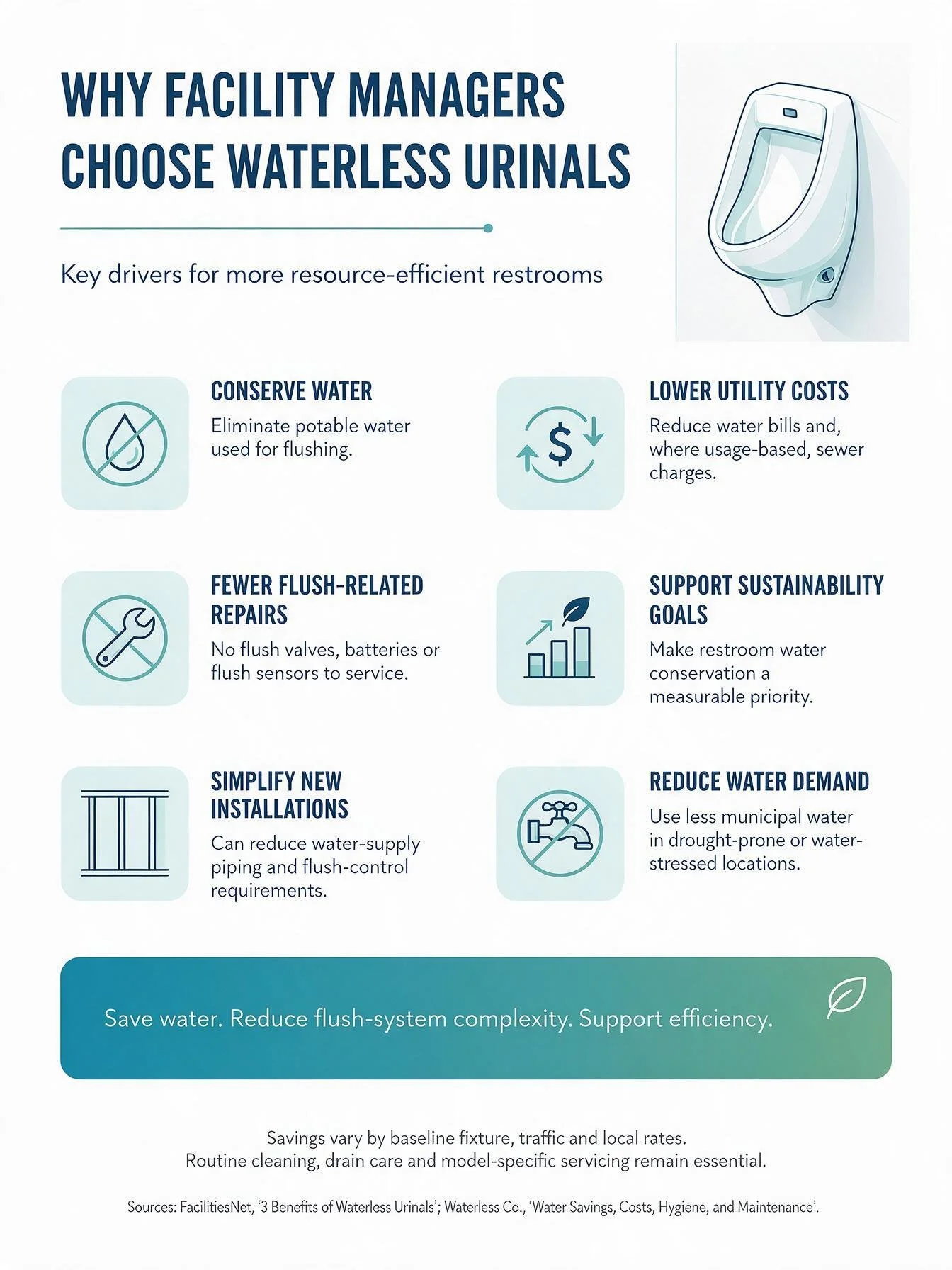
1. Substantial Water and Sewer Cost Savings
The financial return on investment (ROI) is the single biggest driver for adopting waterless technology:
Massive Water Reduction: A single waterless urinal saves between 26,000 and 45,000 gallons of potable water per year, depending on foot traffic and baseline fixture efficiency.
Dual Line-Item Impact: Because most municipal sewer utilities bill based on incoming water volume, savings directly reduce both water consumption and sewer processing fees.
2. Lower Maintenance Burden & Reduced Callouts
Traditional flush urinals contain multiple high-wear, failure-prone mechanical parts:
Fewer Mechanical Failures: Removing flush valves, handles, electronic sensors, and water supply lines eliminates common points of leakage, breakdown, and vandalism.
Predictable Upkeep: Emergency plumbing service calls are replaced by routine, scheduled cartridge maintenance, simplifying facility workflows.
3. Sustainability, LEED Credits & Drought Resilience
Waterless fixtures play a critical role in corporate green building initiatives:
LEED Certification: Water conservation supports key points for LEED (Leadership in Energy and Environmental Design) certification and green building standard compliance.
ESG & Tenant Appeal: Meeting local drought-resilience requirements enhances Environmental, Social, and Governance (ESG) reporting while appealing to eco-conscious tenants.
4. Improved Hygiene and Odor Control
Contrary to common misconceptions, non-water-using fixtures offer distinct sanitation benefits:
Zero Aerosolization: The absence of a flush cycle prevents the airborne dispersion (aerosolization) of microbes into the restroom environment.
Bacteria-Hostile Surface: Dry surfaces discourage bacterial growth and colony formation.
Touch-Free & Sewer Gas Blocking: Non-touch operation minimizes cross-contamination, while specialized liquid sealant cartridges effectively lock out sewer gases.
5. Cheaper, Faster Retrofits and Capital Savings
Installing no-flush urinals is significantly faster and less expensive than traditional installations:
Reduced Construction Expenses: Installers do not need to pull water supply lines, wire electrical connections, or mount complex flush valves.
Minimal Downtime: Lower labor requirements mean faster project completion and reduced disruption to building operations during retrofits.
6. Reduced Pipe Scaling and Clogging Risks
Drain pipe blockage is a primary concern in commercial restrooms:
Less Encrustation: Severe pipe scaling is triggered by the chemical reaction between uric acid and minerals present in flush water. Eliminating flush water significantly slows scale buildup over time.
Zero Overflow Risk: Without stuck flush valves or continuous supply flow, the risk of catastrophic restroom flooding is virtually eliminated.
Key Benefits Takeaways for Facility Leaders
26k–45k gallons of water saved / year / unit
Direct water & sewer bill reduction
No valves, handles, or sensors
Fewer emergency plumbing calls
No supply lines or electrical connections
Lower capital costs & minimal downtime
Zero flush aerosolization
Touchless operation & bacteria reduction