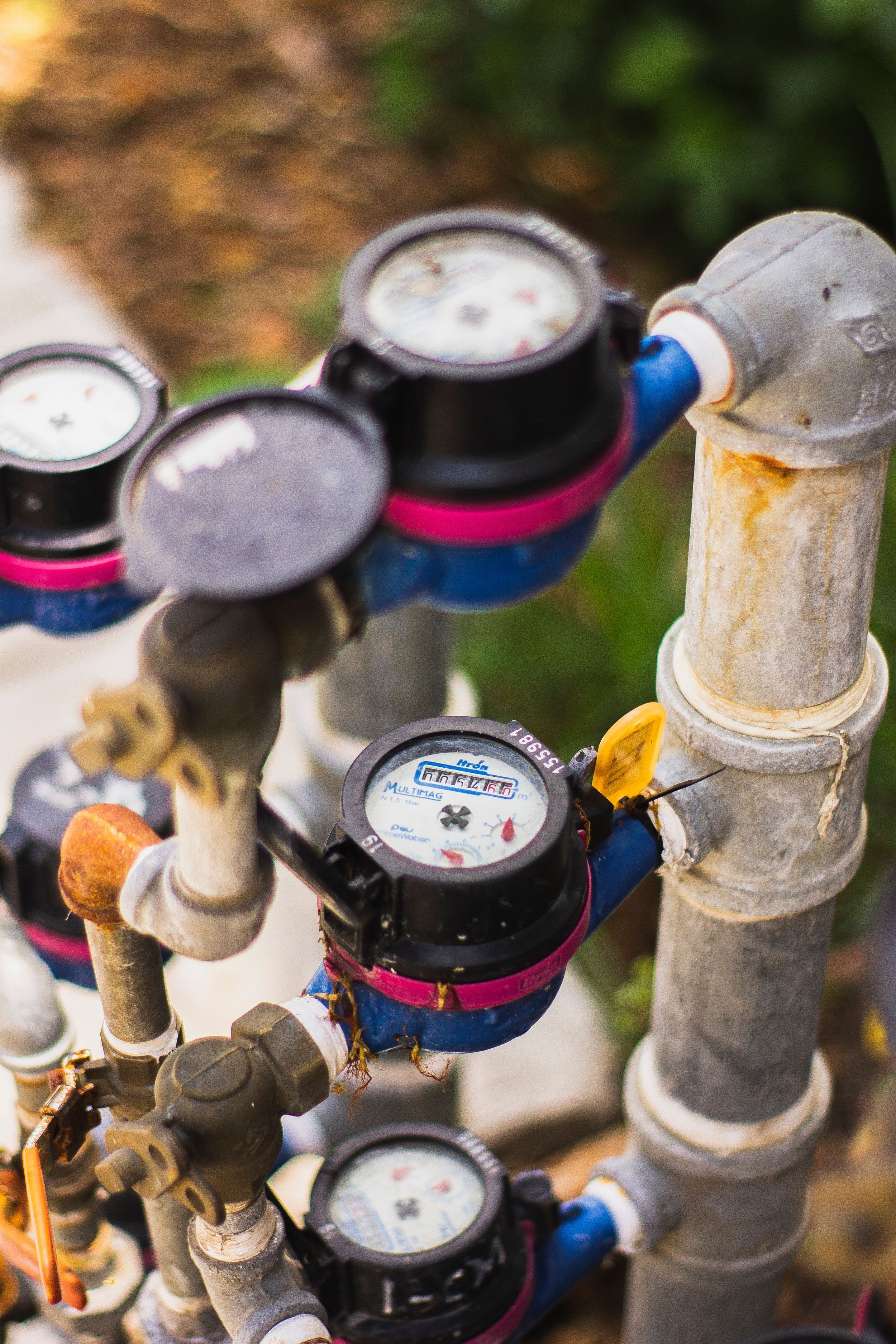
Image by Ian Perelo found on Prexels
1. Establish a Water Baseline and Install Targeted Submeters
A utility meter shows total incoming water use. It does not show which production line, cooling system, or building is responsible for that demand.
Submeters identify water-intensive operations and provide the data needed to improve them. EPA recommends individually metering industrial processes that use more than 1,000 gallons per day on average. Its guidance on metering and submetering also identifies cooling-tower makeup and blowdown lines as important metering locations.
Depending on the facility, priority areas may include:
Production and process equipment
Cooling towers
Boiler and steam systems
Washing and sanitation operations
Restrooms and employee amenities
Recovered or alternative water supplies
Modern metering and information systems can provide real-time usage data. That makes it easier to detect changes and confirm whether efficiency projects deliver the expected results.
2. Find and Fix Leaks and Avoidable Water Waste
Before investing in major equipment replacements, identify losses that maintenance or operating changes can correct.
Start with leaking fixtures, malfunctioning valves, hoses left running, and equipment receiving water when it is not needed. EPA identifies active monitoring, prompt leak detection, and repair as fundamental elements of facility water management.
Assign responsibility for each correction and check usage afterward. A completed repair should produce a measurable result, not just disappear from the maintenance list.
3. Optimize Cooling Towers and Steam Systems
Restroom upgrades are visible, but mechanical systems can represent much larger opportunities.
EPA notes that cooling towers are often among the largest mechanical water users in facilities that have them. It recommends eliminating single-pass cooling where feasible, optimizing cooling-tower operation, and returning steam condensate to boiler systems.
Single-pass cooling deserves close attention. EPA reports that it can use approximately 40 times more water to remove the same heat load as a cooling tower operating at five cycles of concentration.
For manufacturers, a cooling-system review is a potentially high-value starting point, not an afterthought.
4. Evaluate Industrial Water Reuse Where Quality Requirements Allow
Not every application requires drinking-water-quality water.
EPA identifies opportunities to capture, treat, and reuse discharge from one application in another. Potential alternative sources include air-handler condensate, boiler condensate, and other recoverable water streams. Cooling-tower makeup is one possible end use.
Reuse should remain application-specific. Facilities need to determine whether the recovered water is suitable for its intended use, and what treatment, monitoring, and operating controls are necessary. EPA's guidance provides separate practices for different alternative water sources rather than treating reuse as one-size-fits-all.
5. Upgrade Restrooms With Water-Efficient Fixtures, Based on Performance Rather Than Age
A fixture's age alone is not a reliable reason to replace it. A better evaluation considers actual water use, condition, maintenance requirements, and replacement cost.
For flushing urinals, WaterSense-labeled models use 0.5 gallons per flush or less. Non-water-consuming urinals eliminate flushing water entirely. Both options can reduce restroom water demand, but savings depend on the existing fixtures and how often they are used.
Waterless urinals (www.waterless.com) take water efficacy to a much higher level and are worth evaluating in manufacturing facilities with busy employee restrooms. The financial assessment should include:
Existing flush volume and estimated annual use
Applicable water and wastewater charges
Equipment and installation costs
Cartridge or sealant requirements, where applicable
Cleaning labor and preventive drain maintenance
EPA specifically recommends including periodic cartridge replacement and special maintenance requirements when calculating the payback of non-water-consuming urinals. It also notes that proper maintenance helps prevent sediment buildup in drain lines.
The strongest retrofit decision is based on total operating cost, not water savings alone.
6. Build a Cross-Functional Water Management Team
Water management works best when it has clear ownership.
A practical team can bring together maintenance, production, engineering, environmental health and safety, custodial operations, and finance. Its role is to establish the baseline, identify opportunities, assign responsibilities, and evaluate results within a structured water-management program.
Set reduction goals that reflect the facility's actual opportunities. For example:
Reduce unnecessary water use on a specific production line.
Lower cooling-system demand while maintaining required performance.
Eliminate a documented source of continuous water loss.
Reduce restroom flushing-water use through a targeted retrofit.
The objective is a credible improvement plan with accountable owners.
7. Train Employees and Track Water KPIs
Equipment improvements need support from the people who operate and maintain them.
Include water efficiency in employee training: how to report leaks, when to shut off water, how to follow approved cleaning procedures, and how to maintain water-saving fixtures. Best management practices include user education, operating practices, and maintenance as integral parts of water-efficiency programs.
A useful facility scorecard can track:
Total incoming water use
Water use per unit of production
Water and wastewater expenses
Use by major process or system
Leak-repair completion
Verified savings from completed projects
Track both total demand and production-adjusted performance. This helps separate genuine efficiency gains from changes caused simply by producing more or less product.
Frequently Asked Questions
How can manufacturing facilities reduce water usage?
Install submeters on major processes, then fix leaks and avoidable waste. Next, review cooling towers, single-pass cooling, and steam systems, evaluate water reuse where quality allows, and train employees to sustain the savings.
Why does water efficiency reduce manufacturing costs?
Manufacturers may pay to supply, pump, heat, cool, treat, and discharge water. Using less water can reduce the water bill, wastewater charges, and the energy needed to move and condition water inside the plant.
How much does water cost for commercial facilities?
Estimated 2024 national commercial averages at $6.13 per 1,000 gallons for water and $7.23 for wastewater, or $13.36 combined. Actual rates vary by utility, so check your facility's rate schedule.
What should a manufacturer submeter first?
EPA recommends individually metering industrial processes that use more than 1,000 gallons per day on average. It also identifies cooling-tower makeup and blowdown lines as important metering locations.
Are waterless urinals a good fit for manufacturing plants?
Yes, especially in facilities with busy employee restrooms, because they eliminate flushing water entirely. Evaluate total operating cost, including cartridge or sealant replacement, cleaning labor, and preventive drain maintenance.
Turn Water Efficiency Into an Operating Strategy
An effective water conservation program connects measurement with action. Submetering shows where water goes. Maintenance addresses avoidable losses. Cooling-system improvements and appropriate reuse can reduce larger demands. Restroom upgrades add another measurable opportunity, and employee training helps sustain performance.
For manufacturers, the opportunity is not just to buy less water. It is to reduce the unnecessary costs of using it.
Want to explore water-saving restroom options for your facility? Contact a Waterless Co., Inc. representative at 800-244-6364.
About the Author
Klaus Reichardt is founder and CEO of Waterless Co., Inc., based in Vista, California. He established the company in 1991 with a focus on water-efficient plumbing products. The company markets waterless urinals and related restroom products.