When you look at a globe, it is easy to assume that water is an infinite resource. More than 70% of the Earth’s surface is covered by it, after all.
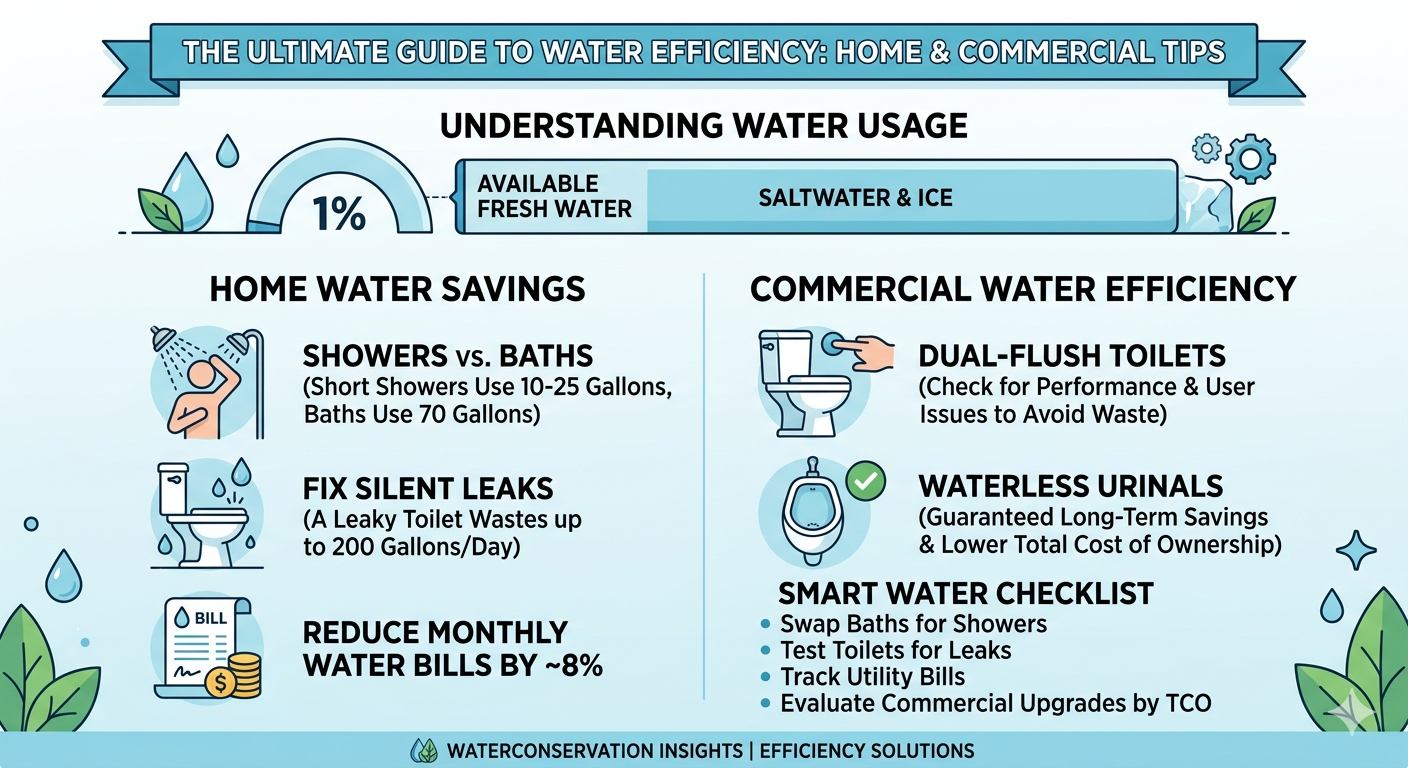
Yet, a look behind that statistic reveals a stark reality: less than 1% of the world’s water is accessible for everyday human use. The rest is locked away as saltwater, frozen in glaciers, or trapped deep underground.
Because our usable water supply is incredibly limited, practicing everyday water efficiency isn't just an environmental ideal, it is a financial necessity. Whether you are managing a household budget or overseeing a multi-story commercial building, understanding how we use (and waste) water is the first step toward significant utility savings.
Why Water Conservation Matters
1. Simple Changes to Reduce Household Water Consumption
Many homeowners assume that conserving water requires drastic lifestyle sacrifices. In reality, major savings come from adjusting a few daily routines and tackling delayed home maintenance.
Showers vs. Baths: Which Uses Less Water?
If you are trying to cut down your monthly utility bill, the choice between a bath and a shower is a clear one. A standard five-minute shower uses 10 to 25 gallons of water. On the other hand, filling a standard bathtub requires about seventy gallons—regardless of how long you spend soaking. By simply prioritizing short showers over baths, a household can save thousands of gallons of water annually.
The True Cost of Hidden Plumbing Leaks
When people think of home water waste, they often picture someone leaving the faucet running while brushing their teeth or running a half-empty dishwasher. While those are bad habits, they pale in comparison to the single biggest water criminal in the home: the leaky toilet.
Did you know? A single running or leaking toilet can quietly waste up to two hundred gallons of water every single day.
Because toilet leaks are often completely silent, they can go unnoticed for months while inflating your utility bills. Taking the time to locate and fix all household plumbing leaks is highly lucrative; data shows that eliminating leaks drops the average monthly household water bill by approximately 8%.
2. Commercial Water Efficiency: Navigating Facility Upgrades
For property and facility managers, the scale of water consumption is much higher, meaning the financial stakes of building upgrades are exponentially greater. However, not all "green" technologies deliver on their promises.
The Hidden Pitfall of Dual-Flush Toilets
On paper, replacing old commercial toilets with manual dual-flush models seems like a foolproof strategy to reduce water consumption by 20%. Unfortunately, real-world data often tells a different story.
Recent facility studies reveal that after installing dual-flush mechanisms, overall building water consumption often goes up instead of down. This unexpected spike usually traces back to two key issues:
Flawed Valve Engineering: Many dual-flush mechanisms are prone to early wear, leading to internal leaks.
User Behavior: In public or corporate settings, users frequently misuse the dual-flush levers or double-flush out of habit, completely erasing the intended efficiency gains.
Upgrading Commercial Restroom Fixtures. Source: Matveev_Aleksandr / Getty Images
Maximizing ROI with Waterless Urinals
Because traditional dual-flush configurations can disappoint, facility managers looking for guaranteed returns are increasingly turning to no-water technology. When removing old, flush-heavy urinals, choosing the right replacement brand comes down to calculating the Total Cost of Ownership (TCO).
While multiple leading manufacturers offer urinals with similar upfront price tags and warranties, the long-term maintenance costs vary wildly. Upfront installation costs are a one-time fee, but ongoing maintenance is continuous.
This is why brands like Waterless Co. Inc. stand out. Their systems utilize the engineered EcoTrap® cylinder, which lasts significantly longer and costs less to replace than competitor trap cartridges. By focusing on the brand that is the least expensive to maintain over its lifecycle, commercial buildings can confidently secure permanent water reductions without unexpected maintenance headaches.
Summary Checklist: Smart Water Savings
Whether at home or at the office, use this quick checklist to maximize your water efficiency:
[] Swap baths for showers to save up to forty-five gallons per wash.
[] Test toilets for silent leaks using food coloring in the tank.
[] Track your utility bills—an unexplained spike usually means a hidden leak.
[] Evaluate commercial upgrades by TCO, factoring in long-term cartridge and maintenance costs rather than just the initial purchase price.