Communities across the United States are finding themselves in an increasingly familiar situation: asking residents and businesses to use less water.
Most recently, the Western Virginia Water Authority announced Stage 1 voluntary water conservation measures after months of below-average rainfall caused reservoir levels to decline. The Authority is encouraging customers to reduce both indoor and outdoor water use before mandatory restrictions become necessary.
While shorter showers and watering lawns less frequently can help during a drought, facility managers and commercial property owners have an opportunity to make changes that reduce water demand every day—not just during emergencies.
Why Water Restrictions Are Becoming the New Normal
Drought conditions are affecting more regions of the country than ever before. As reservoirs shrink and populations grow, water utilities are increasingly relying on voluntary conservation programs to preserve supplies before more severe restrictions become necessary.
For businesses, schools, airports, office buildings, stadiums, and other high-traffic facilities, this raises an important question:
How can buildings permanently reduce water consumption without sacrificing performance?
The answer lies in water efficiency.
Unlike temporary conservation measures, water efficiency reduces water use over the long term through better technology and smarter building design.
Commercial Restrooms Offer One of the Biggest Water-Saving Opportunities
Many commercial buildings have already upgraded to low-flow fixtures. But they are overlooking one restroom fixture that continues to consume thousands of gallons of potable water every year—the urinal.
Even modern flush urinals typically require between 0.125 and 1 gallon of water per use. In busy facilities, those flushes quickly add up to tens of thousands of gallons annually for each fixture.
Waterless urinals eliminate that water use entirely.
Instead of using water to transport waste, specially engineered trap technology creates a seal that blocks sewer gases while allowing waste to pass through safely. The result is a fixture that performs its intended function without consuming drinking water.
The Long-Term Benefits of Waterless Urinals
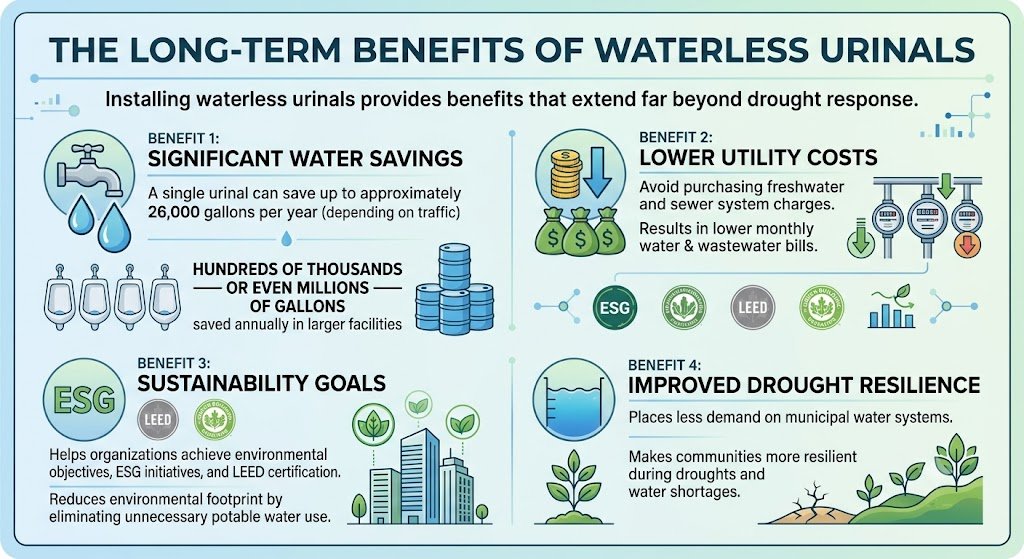
Installing waterless urinals provides benefits that extend far beyond drought response.
Significant Water Savings
Depending on traffic levels, a single waterless urinal can save up to approximately 26,000 gallons of water each year. Multiply that across multiple fixtures, and the annual savings can easily reach hundreds of thousands—or even millions—of gallons in larger facilities.
Lower Utility Costs
Every gallon that isn't flushed is a gallon that doesn't have to be purchased or sent to the sewer system. That means lower water and wastewater bills month after month.
Sustainability Goals
Organizations pursuing ESG initiatives, LEED certification, or broader sustainability goals can reduce their environmental footprint by eliminating unnecessary potable water use in restrooms.
Improved Drought Resilience
Buildings that permanently use less water place less demand on municipal water systems, making communities more resilient during droughts and periods of water shortages.
Temporary Conservation vs. Permanent Water Efficiency
When water restrictions are announced, people are often encouraged to:
Water landscapes only during cooler hours.
Repair plumbing leaks.
Run only full loads in dishwashers and washing machines.
Reduce shower times.
Turn off faucets while brushing teeth.
These are valuable practices and can provide immediate reductions in water use.
However, permanent fixture upgrades deliver savings every day without relying on occupant behavior.
That's the difference between conserving water today and using less water for decades to come.
A Smart Time to Evaluate Restroom Upgrades
The recent voluntary restrictions in western Virginia are another reminder that water is becoming an increasingly valuable resource.
Forward-thinking facility managers don't wait for mandatory restrictions before taking action. They look for technologies that permanently reduce consumption while lowering operating costs.
Waterless urinals represent one of the simplest ways to accomplish both objectives. By eliminating thousands of flushes every year, these fixtures help conserve drinking water, reduce utility expenses, and support long-term sustainability initiatives.
As droughts become more frequent across many parts of the country, investments in permanent water-saving technologies will become just as important as temporary conservation measures.
-Klaus