Waterless urinals are designed to deliver hygienic, odor‑free performance without using a single gallon of water, relying instead on fluid dynamics to block sewer gas. Although cartridge-based and liquid‑replenishment systems achieve the same core function, they differ significantly in how they’re maintained, how much they cost over time, and how much waste they generate.
1. Structural & Operational Differences
Cartridge-Based Waterless Urinals
Use a replaceable, recyclable, plastic cartridge installed in the fixture outlet.
Cartridges contain internal baffles and engineered sealing fluids.
When the life of the cartridge ends, staff should remove the entire cartridge with a key tool and dispose of it.
Predictable, standardized replacement cycles.
Liquid-Replenishment (Trap Insert) Systems
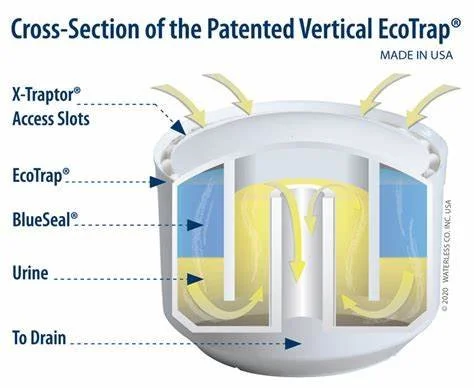
Use a replaceable, trap insert (e.g., EcoTrap).
Maintenance focuses on adding sealant fluid (such as BlueSeal) directly into the trap.
Inserts last far longer and are replaced only occasionally.
Lower waste and fewer specialized parts.
2. Cost & Maintenance Comparison
Consumable Costs
Other Cartridge Based Systems are higher cost. Cartridges cost $30–$50+ each and last 1,500–7,000 uses.
Liquid Replenishment are lower. Sealant fluid costs pennies per refill; trap inserts such as the EcoTrap last 2,000–7,000 uses.
Environmental Impact
Cartridge Based Systems. Nonrecyclable cartridges create more plastic waste due to discarded cartridges.
Liquid Replenishment systems. Minimal plastic waste; bulk liquid replaces single-use housings.
Maintenance Routine
Cartridge Based Systems. Simple swap: remove cartridge, clean, install new one.
Liquid Replenishment systems. Quick top-off: pour sealant into the cartridge as needed.
Tolerance to Accidental Water
Water can wash out cartridge sealant fluid, requiring early replacement.
If water flushes out fluid, simply add 2–3 oz of sealant—no hardware replacement.
3. Daily & Routine Cleaning Best Practices
Use pH-neutral cleaners designed for waterless fixtures.
Never dump mop water or large volumes of liquid into the urinal—this removes the sealant barrier.
Avoid harsh chemicals like bleach, acids, or caustic drain openers.
Wipe surfaces instead of heavy spraying to prevent overwhelming the trap.
Liquid systems: Top off sealant fluid straight into the cartridge.
Cartridge systems: Remove and replace the cartridge; clean the housing.
During cartridge changes:
Flush the drain line with 1–2 gallons of warm water to clear sediment in the drain line before reinstalling the trap.
Pro Tip: Post a “Do Not Pour Mop Water Here” sticker near the fixture or in the janitorial closet. Staff training is the #1 factor in long-term performance.
The Bottom Line
Waterless urinals are simple to care for but still dependent on good maintenance. Both cartridge-based and liquid-replenishment systems deliver reliable, odor-free performance when serviced correctly—but they differ sharply in cost, sustainability, and ease of upkeep. Cartridge systems offer predictable, plug‑and‑play replacements, while liquid-replenishment systems deliver lower long-term costs, less plastic waste, and simpler day‑to‑day care.
For facilities focused on lower operating costs, reduced environmental impact, and straightforward maintenance, liquid-replenishment systems typically provide the strongest long-term value. These are the ones found in urinals marketed by Waterless Co., Inc.