Water Restrictions Are Coming. Here's One Upgrade That Can Save Millions of Gallons.

Communities across the United States are finding themselves in an increasingly familiar situation: asking residents and businesses to use less water.

Most recently, the Western Virginia Water Authority announced Stage 1 voluntary water conservation measures after months of below-average rainfall caused reservoir levels to decline. The Authority is encouraging customers to reduce both indoor and outdoor water use before mandatory restrictions become necessary.

While shorter showers and watering lawns less frequently can help during a drought, facility managers and commercial property owners have an opportunity to make changes that reduce water demand every day—not just during emergencies.

Why Water Restrictions Are Becoming the New Normal

Drought conditions are affecting more regions of the country than ever before. As reservoirs shrink and populations grow, water utilities are increasingly relying on voluntary conservation programs to preserve supplies before more severe restrictions become necessary.

For businesses, schools, airports, office buildings, stadiums, and other high-traffic facilities, this raises an important question:

How can buildings permanently reduce water consumption without sacrificing performance?

The answer lies in water efficiency.

Unlike temporary conservation measures, water efficiency reduces water use over the long term through better technology and smarter building design.

Commercial Restrooms Offer One of the Biggest Water-Saving Opportunities

Many commercial buildings have already upgraded to low-flow fixtures. But they are overlooking one restroom fixture that continues to consume thousands of gallons of potable water every year—the urinal.

Even modern flush urinals typically require between 0.125 and 1 gallon of water per use. In busy facilities, those flushes quickly add up to tens of thousands of gallons annually for each fixture.

Waterless urinals eliminate that water use entirely.

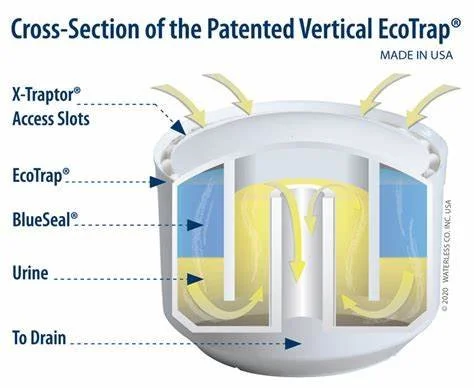
Instead of using water to transport waste, specially engineered trap technology creates a seal that blocks sewer gases while allowing waste to pass through safely. The result is a fixture that performs its intended function without consuming drinking water.

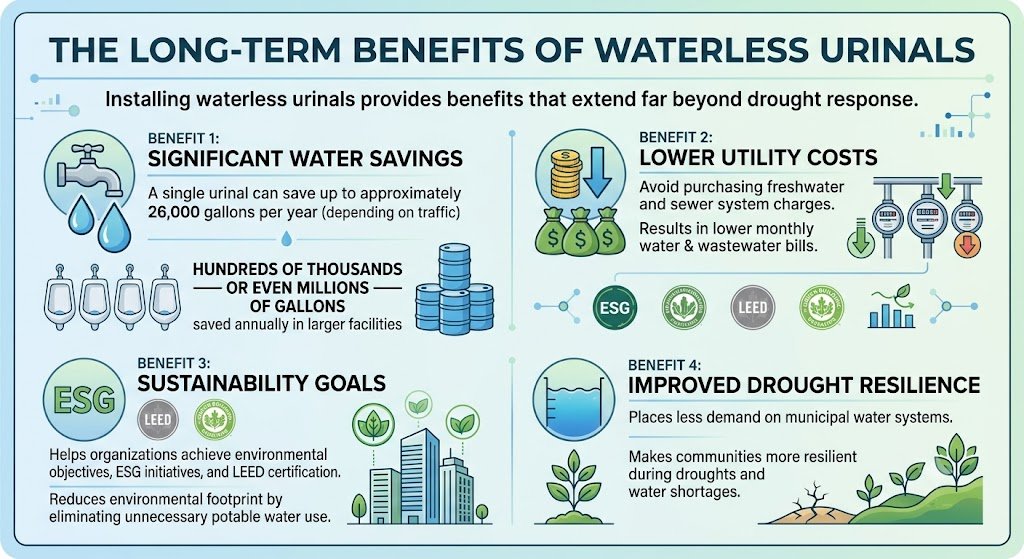
The Long-Term Benefits of Waterless Urinals

Installing waterless urinals provides benefits that extend far beyond drought response.

Significant Water Savings

Depending on traffic levels, a single waterless urinal can save up to approximately 26,000 gallons of water each year. Multiply that across multiple fixtures, and the annual savings can easily reach hundreds of thousands—or even millions—of gallons in larger facilities.

Lower Utility Costs

Every gallon that isn't flushed is a gallon that doesn't have to be purchased or sent to the sewer system. That means lower water and wastewater bills month after month.

Sustainability Goals

Organizations pursuing ESG initiatives, LEED certification, or broader sustainability goals can reduce their environmental footprint by eliminating unnecessary potable water use in restrooms.

Improved Drought Resilience

Buildings that permanently use less water place less demand on municipal water systems, making communities more resilient during droughts and periods of water shortages.

Temporary Conservation vs. Permanent Water Efficiency

When water restrictions are announced, people are often encouraged to:

  • Water landscapes only during cooler hours.

  • Repair plumbing leaks.

  • Run only full loads in dishwashers and washing machines.

  • Reduce shower times.

  • Turn off faucets while brushing teeth.

These are valuable practices and can provide immediate reductions in water use.

However, permanent fixture upgrades deliver savings every day without relying on occupant behavior.

That's the difference between conserving water today and using less water for decades to come.

A Smart Time to Evaluate Restroom Upgrades

The recent voluntary restrictions in western Virginia are another reminder that water is becoming an increasingly valuable resource.

Forward-thinking facility managers don't wait for mandatory restrictions before taking action. They look for technologies that permanently reduce consumption while lowering operating costs.

Waterless urinals represent one of the simplest ways to accomplish both objectives. By eliminating thousands of flushes every year, these fixtures help conserve drinking water, reduce utility expenses, and support long-term sustainability initiatives.

As droughts become more frequent across many parts of the country, investments in permanent water-saving technologies will become just as important as temporary conservation measures.

-Klaus
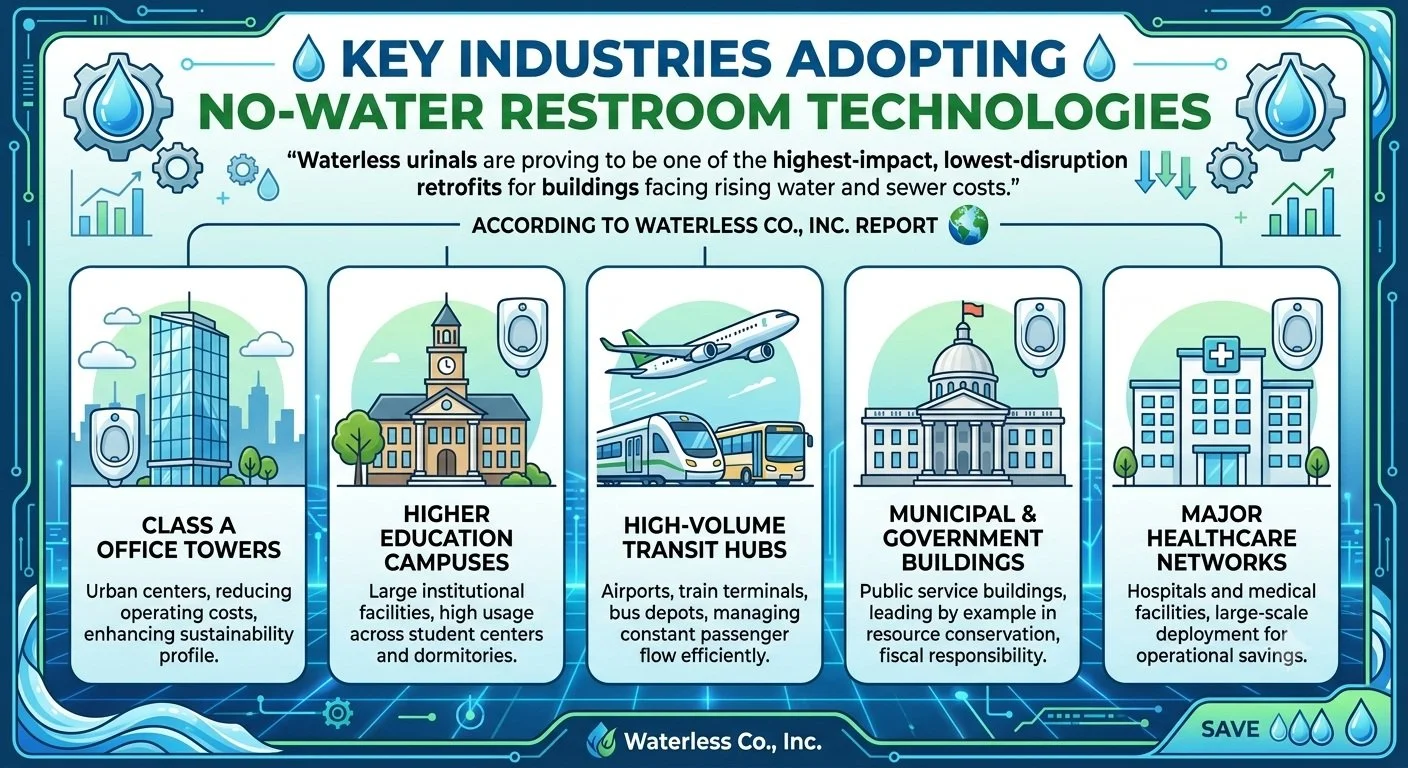
Facilities Most Often Adopting No-Water Restroom Technologies

Waterless urinals are proving to be one of the highest-impact, lowest-disruption retrofits for buildings facing rising water and sewer costs.

According to a Waterless Co., Inc, report, high-traffic commercial and public sectors are leading the transition to water-efficient facilities:

  • Class A Office Towers in urban centers

  • Higher Education Campuses and large institutional facilities

  • High-Volume Transit Hubs (airports, train terminals, and bus depots)

  • Municipal & Government Buildings

  • Major Healthcare Networks

Escalating 2026 Drought Spurs Water Crises for U.S. Farmers, Agriculture, and Supply Chains

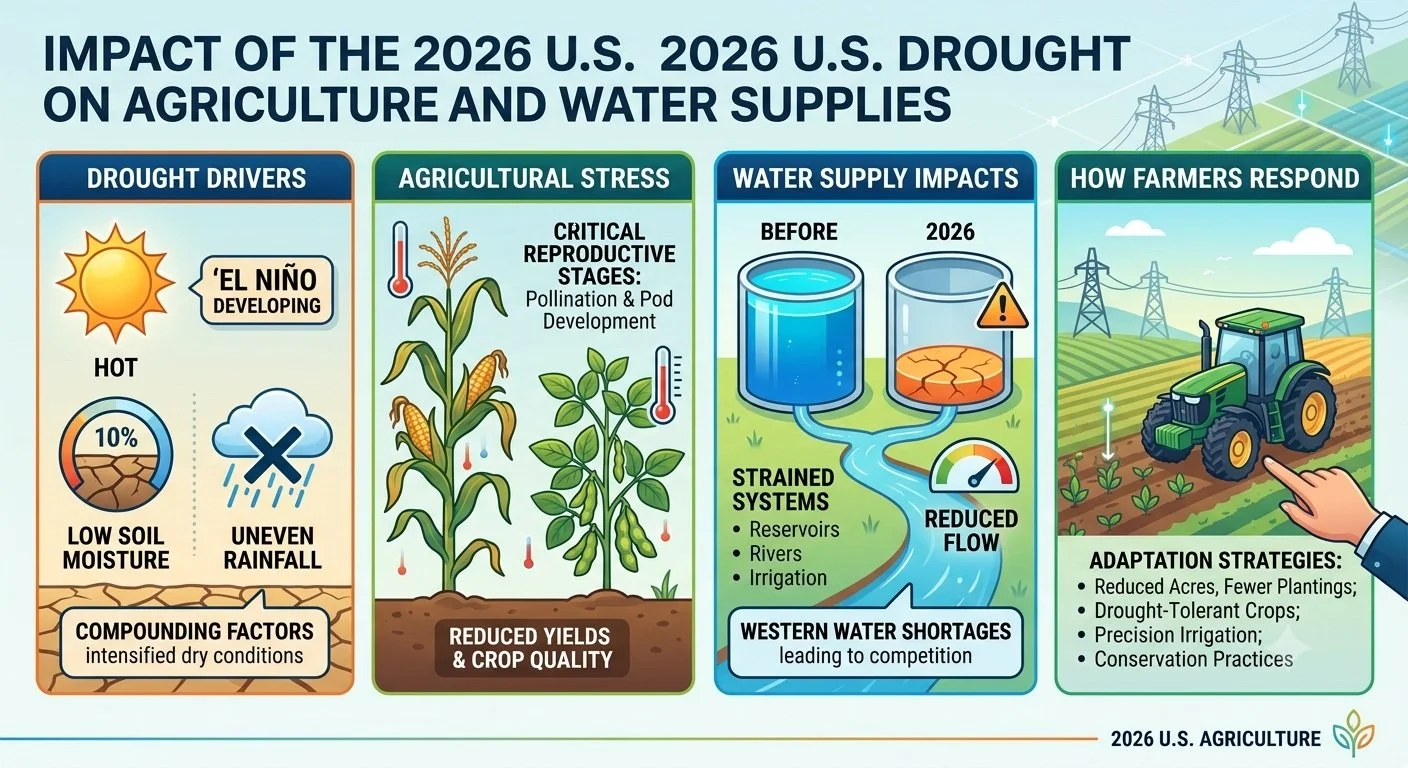
Relentless heatwaves and expanding drought zones across the United States are presenting steep hurdles for the agricultural sector. As the 2026 growing season hits a crucial turning point, producers nationwide face dwindling irrigation reservoirs, stressed crops, and heightened wildfire dangers. These compounding environmental pressures threaten farm productivity, crop yields, and national food stability.

Why the Current Drought Is Devastating American Agriculture

While summer dry spells are expected, a unique combination of extreme weather factors is amplifying the severity of the 2026 drought.

Key Drivers of the Agricultural Strain:

  • Compounding Climate Factors: A developing El Niño pattern paired with sustained high temperatures, low rainfall, and dry topsoil has intensified conditions in major farming hubs.

  • Timing with Critical Growth Phases: Mid-summer is vital for corn and soybean crops entering key reproductive stages—such as pollination and pod development. Heat stress now directly cuts into harvest volume.

  • Depleted Western Reservoirs: Prolonged dry spans across the West have left river basins and municipal water systems severely depleted, triggering strict allocations.

In regions like the Colorado River Basin, fierce competition over shrinking groundwater reserves is forcing a standoff between farm irrigation, urban expansion, and industrial development.

Direct Impacts on Farmers and Regional Farming Shifts

The agricultural sector is confronting both short-term operational hurdles and long-term structural shifts.

  • Immediate Operations: Reduced water allocations force row-crop producers, fruit growers, and nurseries to cut back planted acreage, stall farm expansions, or pivot toward drought-resistant crop varieties.

  • Geographic Shifts in Specialty Crops: States like California—long the leader in fruit, nut, and vegetable production—face ongoing water restrictions. This scenario creates potential opportunities for growers in wetter regions to fill supply shortages, provided they can establish necessary infrastructure and distribution channels.

The Rising Battle Over Water Rights

Groundwater and surface supply competition is no longer just a farm issue—it is a regional development conflict.

The Big Challenge: Agriculture is competing directly with high-water-demand industries, including solar farms, data centers, and expanding residential suburbs.

To safeguard the future of American agriculture, stakeholders are advocating for a two-pronged strategy:

1.    Policy Reform: Smarter state-level growth policies, development limits in water-scarce zones, and updated infrastructure.

2.    On-Farm Innovation: Widespread adoption of precision irrigation, drought-tolerant crop seeds, and cooperative water-sharing models.

Supply Chain Risks and Consumer Food Prices

Prolonged drought in major agricultural belts eventually impacts consumer wallets. Unfavorable late-season weather and strict irrigation cuts can drive up retail grocery prices and shrink store supplies. While the ultimate economic impact depends on late-summer rainfall, the 2026 crisis underscores water availability as the single most critical asset in food production.

How Urban and Suburban Communities Can Help Relief Efforts

Urban and suburban water use directly impacts the larger hydrological ecosystem. Conserving water isn't just about taking shorter showers—it’s about implementing long-term water efficiency to permanently reduce demand on municipal systems.

Simple, High-Impact Efficiency Upgrades:

  • Upgrade Household Fixtures: Install high-efficiency toilets rated at 1.28 gallons per flush (GPF) or lower to permanently slash residential use.

  • Modernize Commercial Facilities: Schools, offices, and commercial sites can transition to waterless urinals to eliminate thousands of gallons of daily waste.

By cutting municipal water demand at scale, off-farm communities can help ease the burden on regional reservoirs, preserving essential water supplies for the farms that feed the nation.

Corpus Christi’s Water Shortage: A Cautionary Tale for Growing Cities

Image by Rejesh Balouria found on Prexels

An extended, multi-year drought coupled with delayed infrastructure decisions has pushed Corpus Christi, Texas, into a high-stakes water scarcity crisis. Although recent rainfall and stormwater runoff provided temporary relief by pushing back immediate "day zero" forecasts, the area's supply remains critically vulnerable—threatening residents, local commerce, major industrial facilities, and neighboring Coastal Bend municipalities alike.

Serving roughly 500,000 residents as well as heavily water-dependent refineries and petrochemical plants, Texas’ eighth-largest city operates a regional water network on the brink.

Investigative reporting from Inside Climate News and the Texas Newsroom highlights that Corpus Christi could become one of the first major American cities in modern history where municipal water demand outpaces available supply. Prior to recent precipitation, severe drought conditions had experts warning that the city’s primary reservoirs could be entirely depleted within a year.

Understanding the Thresholds: Drought, Reservoirs, and Emergency Protocols

To manage potential shortfalls, municipal officials have outlined aggressive conservation strategies, including a Level 1 Water Emergency that would require a 25% across-the-board usage reduction for residential, commercial, and industrial sectors.

  • The Trigger: A Level 1 Emergency is declared when city water reserves are estimated to be within 180 days of failing to meet daily demand.

  • Uncharted Territory: Reflecting the unprecedented nature of the drought, City Manager Peter Zanoni noted to the City Council, "We have no precedent to follow. There’s no manual, there’s no video."

  • Enforcement & Pushback: Proposed compliance mechanisms include financial surcharges, heavy fines, and potential service disconnections for chronic violators—though Mayor Paulette Guajardo has firmly opposed cutting off residential access.

Impacts on Local Industry and Daily Life

The uncertainty of potential mandates has created concern across the regional economy. Essential facilities such as medical centers, public schools, and major employers face operational hurdles. For example, a representative for H-E-B—which runs a large commercial bakery in the city—stated to Inside Climate News that the lack of specific guidance from city officials makes it difficult to assess how business operations might be disrupted.

The Broader Picture: Industrial Expansion vs. Climate Reality

Environmental researchers emphasize that the convergence of accelerating climate change, swift industrial expansion, and delayed resource management compounds regional drought hazards.

"What we’re seeing in Corpus Christi is really not an isolated crisis," noted Shannon Marquez, a professor at the Columbia Water Center, in an interview with Grist. "It’s very consistent with how things are going to unfold if we don’t start to plan."

Proactive Steps for Businesses and Public Institutions

While long-term infrastructure fixes remain unresolved, commercial facilities, educational institutions, and public venues can take immediate action to mitigate usage:

  • Retrofit High-Traffic Restrooms: Swap out outdated plumbing with low-flow faucets, high-efficiency toilets, and waterless urinals to instantly curb daily consumption.

  • Prioritize Large-Capacity Facilities: Focus efficiency upgrades on high-density environments first, such as manufacturing plants, office complexes, and school campuses.

  • Mitigate Financial and Operational Risk: Proactive water conservation lowers monthly utility overhead today while protecting organizations against future emergency surcharges or regulatory penalties if Stage 3 restrictions or Level 1 mandates take effect.

While late-season rains bought the region valuable time, Corpus Christi's underlying water supply challenge remains unresolved. Moving forward, monitoring reservoir capacity, conservation stage triggers, and regional policy decisions will be vital for anyone tracking the Coastal Bend water crisis.

As Drought Spreads This Summer, Water Efficiency Isn't Optional Anymore

image found on Prexels

Summer has just started, and already most of the country is dealing with dry conditions. Higher temperatures, thin rainfall, and rising demand are converging in a way that's putting real pressure on farms, businesses, and entire water systems — and the strain is only expected to build as the season goes on.

Just How Widespread Is It?

Data from the National Drought Mitigation Center at the University of Nebraska-Lincoln paints a stark picture: only Michigan, Indiana, Ohio, Alaska, and Hawaii have zero land currently classified as drought-affected — and Ohio is the sole state without even "abnormally dry" conditions anywhere within its borders.

That means nearly every other state in the country has at least some portion of land in moderate drought or worse, with the West, the High Plains, and parts of the Southeast bearing the brunt of sustained heat.

What the Drought Scale Actually Means

Drought severity is tracked on a five-tier scale, running from D0 (Abnormally Dry) up to D4 (Exceptional Drought). Once an area reaches D1 — Moderate Drought — the effects start showing up in tangible ways: crop yields slip, pastures thin out, water systems come under strain, and wildfire risk climbs.

Two States Standing Out for the Worst Reasons

Conditions are uneven across the country, but Colorado and North Carolina are taking the hardest hits right now.

  • Colorado — roughly 97% of the state is in at least Moderate Drought, and more than 9% has escalated all the way to Exceptional Drought (D4).

  • North Carolina — over 90% of the state is sitting at Severe Drought (D2) or beyond, with more than 7% in the most extreme category — the kind of territory where mandatory water restrictions and serious agricultural strain tend to follow.

Why Drought Doesn't Look the Same Everywhere

Two towns in the same state can experience drought very differently. Local rainfall totals, reservoir capacity, groundwater reserves, and how well a community manages its water supply all shape the outcome — meaning shared weather doesn't guarantee shared impact.

Farmers Are Already Paying the Price

Dry conditions are showing up directly in crop health. Nationally, about 46% of the winter wheat crop across the High Plains is rated poor or very poor right now. The state-by-state numbers are even more sobering:

  • Nebraska: 83% poor or very poor

  • Colorado: 63%

  • Kansas: 55%

If the dryness continues through the rest of the growing season, expect ripple effects on both crop yields and grocery prices.

The West Isn't Catching a Break

Across the northern reaches of the western U.S., higher-than-normal temperatures are speeding up evaporation and drawing down water supplies faster than usual. Water managers are keeping a close eye on reservoirs and snowpack recovery, bracing for further shortages if the pattern holds.

A Bit of Relief — For Now

Parts of the Midwest and Northeast have seen some recent rain, offering short-term relief. But forecasters aren't ready to call it a trend — if extended heat waves move in later this summer, those gains could disappear quickly.

Why This Puts Water Efficiency Front and Center

As drought conditions widen their reach, cutting unnecessary water use becomes one of the most reliable tools communities and businesses have for protecting a shrinking resource.

The key distinction: water efficiency isn't the same as emergency rationing. It's about making lasting changes that reduce consumption permanently, without sacrificing performance or comfort for the people using the building.

A few practical starting points for organizations and property owners:

  • Switch to water-efficient fixtures, such as waterless urinals

  • Replace thirsty landscaping with drought-tolerant plants and xeriscaping

  • Catch and fix leaks before they become costly

  • Track water use closely enough to spot unusual spikes

  • Build a culture of conscious water use across homes, offices, schools, and public spaces

As dry conditions continue to spread across the map, investing in water-efficient technology now is one of the clearest ways to build resilience, cut long-term operating costs, and protect a resource that's only becoming more valuable.

Sources: National Drought Mitigation Center, University of Nebraska-Lincoln; The New York Times Heat Tracker

Waterless Urinals: What AI Says About How They Work and Why They Matter

Waterless urinals are designed to deliver hygienic, odor‑free performance without using a single gallon of water, relying instead on fluid dynamics to block sewer gas. Although cartridge-based and liquid‑replenishment systems achieve the same core function, they differ significantly in how they’re maintained, how much they cost over time, and how much waste they generate.

1. Structural & Operational Differences

Cartridge-Based Waterless Urinals

  • Use a replaceable, recyclable, plastic cartridge installed in the fixture outlet.

  • Cartridges contain internal baffles and engineered sealing fluids.

  • When the life of the cartridge ends, staff should remove the entire cartridge with a key tool and dispose of it.

  • Predictable, standardized replacement cycles.

Liquid-Replenishment (Trap Insert) Systems

  • Use a replaceable, trap insert (e.g., EcoTrap).

  • Maintenance focuses on adding sealant fluid (such as BlueSeal) directly into the trap.

  • Inserts last far longer and are replaced only occasionally.

  • Lower waste and fewer specialized parts.

2. Cost & Maintenance Comparison

Consumable Costs

Other Cartridge Based Systems are higher cost. Cartridges cost $30–$50+ each and last 1,500–7,000 uses.

Liquid Replenishment are lower. Sealant fluid costs pennies per refill; trap inserts such as the EcoTrap last 2,000–7,000 uses.

Environmental Impact

Cartridge Based Systems. Nonrecyclable cartridges create more plastic waste due to discarded cartridges.

Liquid Replenishment systems. Minimal plastic waste; bulk liquid replaces single-use housings.

Maintenance Routine

Cartridge Based Systems. Simple swap: remove cartridge, clean, install new one.

Liquid Replenishment systems. Quick top-off: pour sealant into the cartridge as needed.

Tolerance to Accidental Water

Water can wash out cartridge sealant fluid, requiring early replacement.

If water flushes out fluid, simply add 2–3 oz of sealant—no hardware replacement.

3. Daily & Routine Cleaning Best Practices

  • Use pH-neutral cleaners designed for waterless fixtures.

  • Never dump mop water or large volumes of liquid into the urinal—this removes the sealant barrier.

  • Avoid harsh chemicals like bleach, acids, or caustic drain openers.

  • Wipe surfaces instead of heavy spraying to prevent overwhelming the trap.

  • Liquid systems: Top off sealant fluid straight into the cartridge.

  • Cartridge systems: Remove and replace the cartridge; clean the housing.

During cartridge changes:

  • Flush the drain line with 1–2 gallons of warm water to clear sediment in the drain line before reinstalling the trap.

Pro Tip: Post a “Do Not Pour Mop Water Here” sticker near the fixture or in the janitorial closet. Staff training is the #1 factor in long-term performance.

The Bottom Line

Waterless urinals are simple to care for but still dependent on good maintenance. Both cartridge-based and liquid-replenishment systems deliver reliable, odor-free performance when serviced correctly—but they differ sharply in cost, sustainability, and ease of upkeep. Cartridge systems offer predictable, plug‑and‑play replacements, while liquid-replenishment systems deliver lower long-term costs, less plastic waste, and simpler day‑to‑day care.

For facilities focused on lower operating costs, reduced environmental impact, and straightforward maintenance, liquid-replenishment systems typically provide the strongest long-term value. These are the ones found in urinals marketed by Waterless Co., Inc.

Rising Water Rates Drive Demand for Water-Efficient Technologies, Reports Waterless Co., Inc.

VISTA, Calif. – July 21, 2026 – As commercial property managers nationwide face escalating utility expenses, a new report from Waterless Co., Inc. highlights how surging local water and sewer rates are accelerating the shift toward commercial water efficiency.

While the analysis focuses on Chicago’s utility structures, market analysts stress that these financial pressures are impacting commercial real estate from coast to coast.

The Double-Charge Dilemma: Dual-Billing Amplifies Utility Costs

Many municipalities nationwide bill sewer services at the exact same rate as freshwater consumption. In Chicago, for example, the combined rate sits at approximately $9.76 per 1,000 gallons. This means every gallon of water consumed—and subsequently flushed down the drain—incurs a double charge.

To address this, reduce costs, and improve sustainability, building owners are advised to install waterless urinals. Here’s why:

  • Industry data shows that a single waterless urinal saves up to 26,000 gallons of water annually.

  • A midsize commercial facility consuming 300,000 gallons per month can reduce total water usage by 15% to 25% by upgrading to no-water fixtures, resulting in significant annual utility savings.

This drive to modernize comes as municipal utility rates continue an upward trajectory. Chicago’s recent 2.43% increase in select municipal service fees reflects a broader national trend of rising water prices driven by aging infrastructure and shifting demand.

High-Traffic Commercial Sectors Leading the Shift to Waterless Restrooms

"Waterless urinals are proving to be one of the highest-impact, lowest-disruption retrofits for buildings facing rising water and sewer costs," said Klaus Reichardt, Founder and CEO of Waterless Co., Inc.

According to the analysis, key sectors adopting no-water restroom technologies to hedge against rising rates include:

  • Downtown Class A Office Buildings

  • Large Educational Campuses

  • High-Volume Transit Hubs (airports, train stations, and bus terminals)

  • Municipal and Government Buildings

  • Major Healthcare and Hospital Facilities

A Coast-to-Coast Commercial Real Estate Trend

The economic pressures prompting Midwest building owners to adapt are reflected in metropolitan areas across the United States.

"We used Chicago as a key benchmark because it represents major metropolitan infrastructure," Reichardt added. "The cost trends occurring there serve as an indicator of what is happening—or will soon happen—in commercial markets nationwide."

About Waterless Co., Inc.

Pioneering water conservation since 1991, Waterless Co., Inc. introduced no-flush urinal technology to North America. Headquartered in Vista, California, the company remains a market leader in commercial water efficiency, offering a complete line of Waterless No-Flush™ urinals, eco-friendly cleaning solutions, and cost-saving restroom accessories.

To learn more about reducing commercial building utility costs, visit www.waterless.com.

Media & Company Contact Information

Waterless Co., Inc.

1050 Joshua Way

Vista, CA 92081 USA

Phone: 800.244.6364

Email: sales@waterless.com

Media Contact: Robert Kravitz

Phone: 312-880-8176

Email: robert.kravitz@outlook.com

Five Essential Steps for Cleaning Waterless Urinals

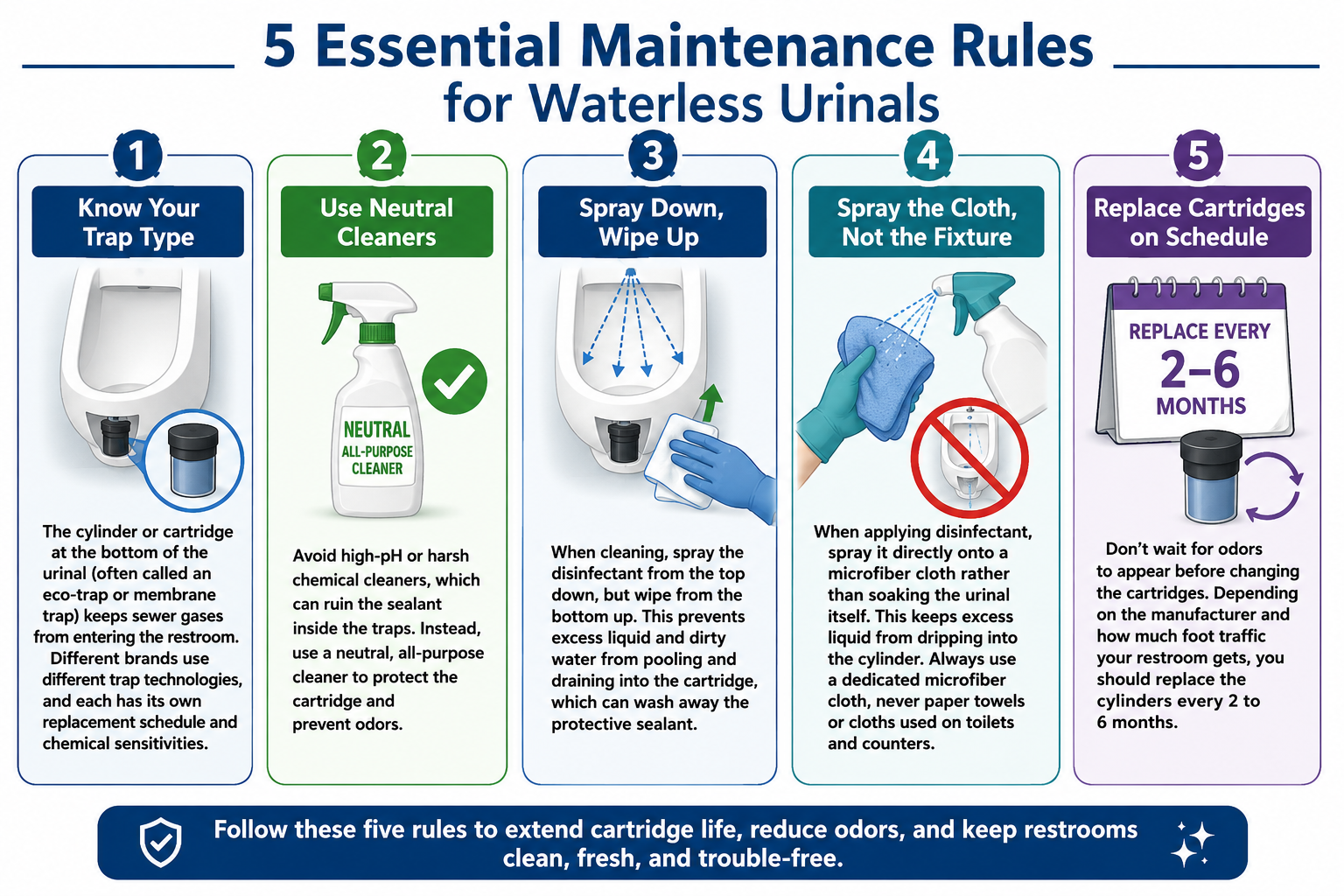
1. Know Your Trap Type: The cylinder or cartridge at the bottom of the urinal (often called an eco-trap or membrane trap) keeps sewer gases from entering the restroom. Different brands use different trap technologies, and each has its own replacement schedule and chemical sensitivities.

2. Use Neutral Cleaners: Avoid high-pH or harsh chemical cleaners, which can ruin the sealant inside the traps. Instead, use a neutral, all-purpose cleaner to protect the cartridge and prevent odors.

3. Spray Down, Wipe Up: When cleaning, spray the disinfectant from the top down, but wipe from the bottom up. This prevents excess liquid and dirty water from pooling and draining into the cartridge, which can wash away the protective sealant.

4. Spray the Cloth, Not the Fixture: When applying disinfectant, spray it directly onto a microfiber cloth rather than soaking the urinal itself. This keeps excess liquid from dripping into the cylinder. Always use a dedicated microfiber cloth, never paper towels or cloths used on toilets and counters.

5. Replace Cartridges on Schedule: Don't wait for odors to appear before changing the cartridges. Depending on the manufacturer and how much foot traffic your restroom gets, you should replace the cylinders every 2 to 6 months.

Water Efficiency Isn’t Just Technology—It’s Behavior

Advances in water-efficient technology over the past two decades have been significant.

From drought-resistant crops to high-efficiency appliances and waterless systems, innovation has helped reduce water use across agriculture, residential, and commercial sectors. These improvements are critical as utilities and communities face growing pressure from climate change, population growth, and aging water infrastructure.

But there is a persistent gap in how we approach water conservation.

Technology alone does not guarantee lower water use.

The Rebound Effect in Water Use

One of the most overlooked challenges in water efficiency is the rebound effect—when efficiency gains lead to increased consumption.

For example, users may take longer showers when using low-flow fixtures because they perceive them as “saving water.” The result is that expected water savings are partially—or completely—erased.

This dynamic highlights a key issue in water demand management: human behavior can undermine even the most advanced technologies.

Water Efficiency Requires Behavior Change

To achieve sustained reductions in water use, utilities and policymakers must adopt a two-part strategy:

  • Implement water-efficient technologies that permanently reduce water consumption

  • Influence user behavior through targeted interventions

A perfect example of the first strategy is transferring to waterless urinals.  They use no water, do not need water to work effectively, and save thousands of gallons of water day after day.

The second, behavior change, can best be explained in the case study below.

Case Study: Behavioral Nudges in Belen, Costa Rica

A widely cited example of behavior-based water conservation comes from Belen, Costa Rica—a community facing increasing water stress due to climate change and infrastructure leakage.

Despite awareness campaigns, residents believed they were already conserving water. At the same time:

  • Most did not understand their actual water consumption

  • Water bills were difficult to interpret

  • There was no visibility into how their usage compared to others

This is a common challenge across many utilities in North America as well.

Low-Cost Interventions, Measurable Results

To address these issues, local officials redesigned water bills and introduced behavioral nudges:

  • Red indicators signaled above-average water use

  • Green indicators reinforced efficient behavior

  • Social comparison provided context relative to neighbors

  • Goal-setting prompts encouraged residents to commit to reducing water use

Over an eight-month period:

  • Households receiving peer comparison feedback reduced water use by 1.5%

  • Those who also committed to specific goals reduced usage by nearly 2%

These results demonstrate how small, low-cost interventions can deliver measurable improvements in water conservation.

Why This Matters for Water Utilities

For water professionals, this case reinforces an important principle:

Behavior is a critical component of water infrastructure performance.

Utilities often invest heavily in physical systems but underutilize behavioral tools such as:

  • Usage feedback and benchmarking

  • Simplified, transparent billing

  • Social norm messaging

  • Customer engagement strategies

These approaches are inexpensive, scalable, and highly effective in reducing water demand.

The Path Forward

As water scarcity intensifies across regions in the U.S. and Canada, integrating behavioral science into water conservation strategies will become increasingly important.

Efficiency is not just about better fixtures or systems—it is about how people use them.

And in many cases, a well-designed nudge can achieve what technology alone cannot.

-Klaus